
A few months ago a Munich audio brand sent us a housing that three other shops had already quoted. All three had planned it as a 3-axis job with five separate set-ups — and five quiet chances for the machined faces to drift out of true position. That is the trap 5-axis machining exists to remove, and it is why we lead with set-ups, not axis counts.
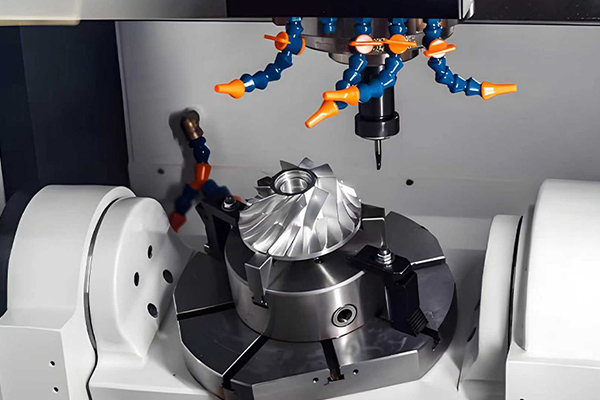
What 5-Axis Actually Changes for Your Part
Terminology drifts between drawings, RFQ forms and supplier websites: the same capability shows up as 5-axis machining, 5 axis CNC machining and five axis CNC machining. They are one thing — a machine that moves the tool or the workpiece across five axes, three linear plus two rotary — and any shop quoting one should be quoting the others. If a quote comes back with a different axis count than you specified, that is worth one question before the order is released.
The detail that matters is not the axis count, it is the set-up count. A conventional 3-axis machine moves the tool along X, Y and Z with the part clamped in one orientation, so every extra face you machine costs another unclamp-and-reclamp. Each of those carries a small alignment error. A 5-axis machining centre adds two rotary axes — usually A (tilt about X) and C (rotate about Z) — in a trunnion table, the spindle head, or both. The part tilts and turns while it is cut, so deep cavities, undercuts and sculpted free-form surfaces that are awkward on 3-axis equipment become routine. Machining five faces in one clamping is also why we can hold tight true-position relationships between features that face in different directions — the usual reason 5-axis is the default for aerospace structures, impellers, medical implants and the high-end audio enclosures we build every week.
5-Axis Turning and Mill-Turn
5-axis turning — usually a mill-turn centre — pairs a lathe's rotational workholding with driven tooling and a B-axis milling spindle. Turning, off-centre drilling, flats and side pockets all finish on one machine in a single clamping, instead of routing the part between a lathe and a machining centre. It earns its keep whenever a rotational part also carries off-axis features: cross-holes, keyways, flats, side ports or asymmetric pockets. Connector bodies, sensor housings, instrument knobs and aerospace fittings are typical. It is a natural extension of our CNC turning service, and we cover it in more depth in the CNC turning service guide.
Simultaneous vs 3+2: Which One Your Part Needs
Simultaneous 5-axis moves all five axes at once and is what free-form surfaces demand — impellers, turbine blades, orthopaedic implants, sculpted audio housings. '3+2' positioning locks the part at a fixed angle and cuts in three axes: simpler, more rigid because the rotary axes are locked, and cheaper per hour. Most prismatic parts that simply have features on more than one face are happy in 3+2. Asking a shop which mode it intends to run tells you more than asking whether it owns a five-axis machine at all — the numbers behind that choice, facet error, tool reach and rotary tolerance, are in our 3+2 vs simultaneous 5-axis guide.
Why We Quote Set-ups, Not Axis Counts
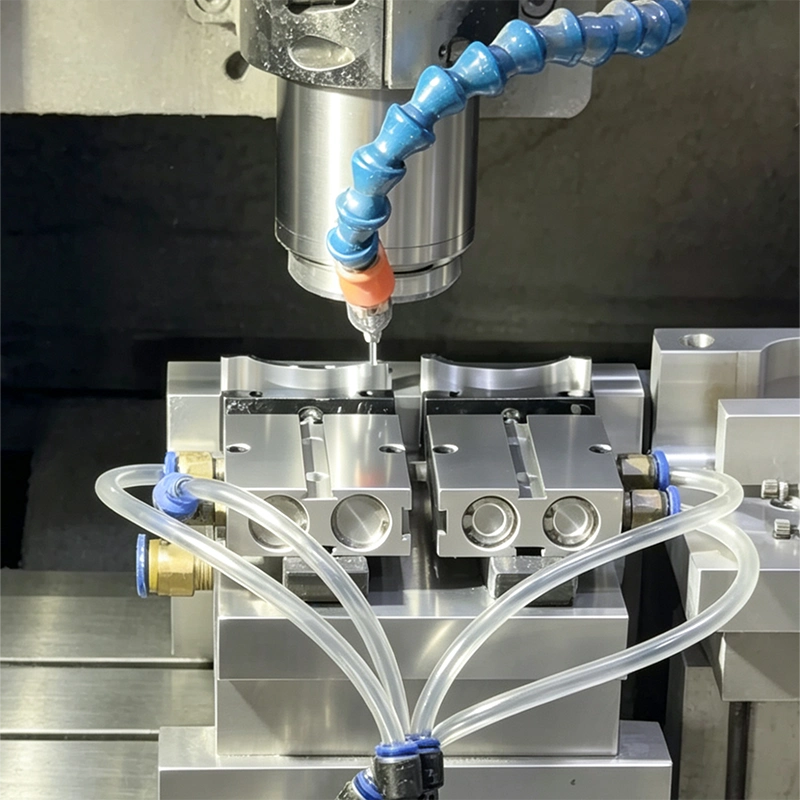
A 3-axis part can need several re-fixturings, each one a fresh chance for location error. 5-axis finishes the part in one clamping, so accuracy and consistency improve together. The practical question for a buyer is not "do you have 5-axis" but "what is your largest 5-axis envelope, and what tolerance do you hold at that envelope". A shop with one small trunnion 5-axis and a shop running large gantry-style centres are not quoting the same part — we see this gap constantly on incoming RFQs, and it is the most common reason two quotes for the "same" 5-axis job look nothing alike. How we hold a part that tilts, and why that is a different problem from 3-axis clamping, is set out in our 5-axis fixturing guide.
Where 5-Axis Earns Its Rate — and Where It Doesn't
5-axis reaches undercuts, deep cavities and angled features that 3-axis cannot touch, and it removes the set-ups and second operations on complex parts. For a bracket that needs five faces, that is one set-up instead of five, and we routinely hold ±0.01 mm across faces on a single part because the part never leaves the fixture. The line where 3-axis still wins is simple prismatic work at volume. If your part is a flat plate with holes on one face, a 3-axis machine — or a 3-axis with a fourth-axis indexer — beats 5-axis on hourly rate every time. Paying 5-axis rates for geometry that does not need it is the single most common specification mistake we see on RFQs.
Position callouts are where most of that argument lands, and our true position tolerance guide explains why the datum order moves the reported number more than the machine does.
Reading a 5-Axis Machine Spec Sheet
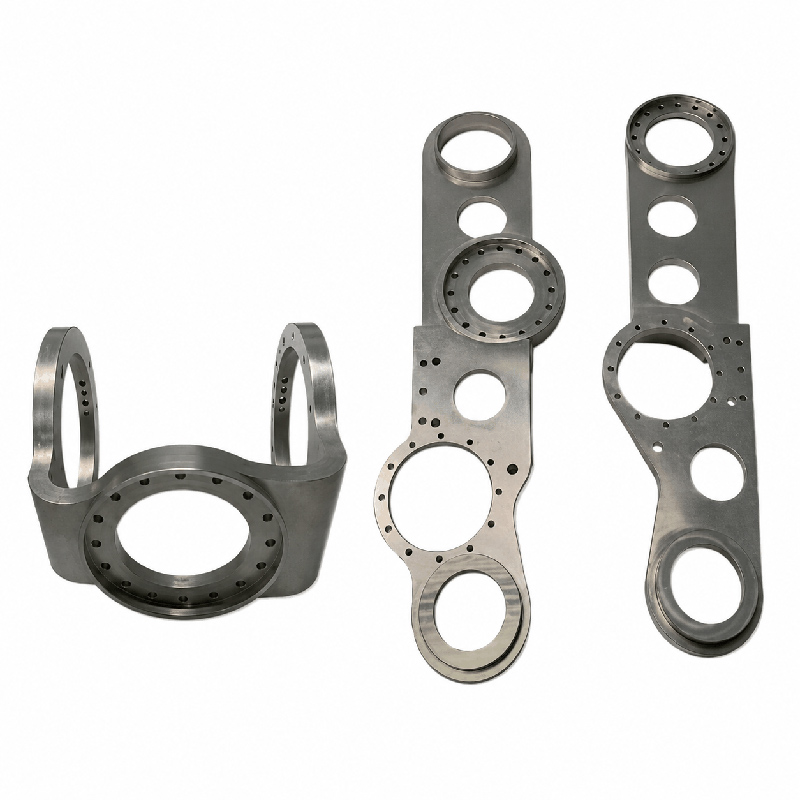
Not all 5-axis machines behave the same in production. The architecture decides which parts they handle. Table-table (trunnion) puts both rotary axes under the workpiece: rigid, but the table eats load capacity, so it suits smaller parts. Head-head tilts the spindle instead and carries full weight on the table, good for heavy parts but capping reach angle. Head-table — one rotary axis in each — is the compromise most shops run and the configuration across most of our 200+ CNC machines. Trunnion add-ons bolt a tilting table into a standard VMC: the cheapest way in, usually up to about 500 mm parts.
Two more things separate a genuine simultaneous machine from a 3-axis mill with a rotary bolted on. The first is true tool-centre-point control (TCP / RTCP / TCPM): with it, the controller keeps the tip at the programmed point while the rotary axes move, so a program ports between machines and a tool-length change needs no re-post. Without it, every tool change becomes a manual recompute and real 5-axis work stops being economical. The second is rotary brake torque and repeatability — in 3+2 work the brake carries the whole cutting load, and weak brakes show up as chatter on the tilted face on a part that measures good on the machine but shifts when unclamped. If you are evaluating a supplier, ask whether TCP is enabled; it is the clearest single sign their 5-axis is real. The tolerance question that follows every 5-axis enquiry is covered in our CNC machining tolerance guide.
Large Part 5-Axis CNC Machining: What Changes Above Ø400 mm
Most of the 5-axis capacity on the market is built around small parts. A trunnion table that swings happily under a 200 mm blank starts fighting you at 500 mm: the brake carries the whole weight of the part through the rotary axis, tool reach grows, and the tilted face becomes a long lever arm cutting at the edge of the envelope. That is why large part 5 axis CNC machining is decided less by axis count than by three numbers — the travels, the largest part the rotary axes can swing without a collision, and the tolerance a shop will still put in writing at that size. We publish the full envelope check, including the swept-cylinder test, in our large part 5-axis machining guide.
| Travels (X / Y / Z) | up to 750 × 650 × 500 mm |
|---|---|
| Rotary axes | A/C trunnion, ±120° / 360° |
| Max part size | up to Ø500 × 400 mm |
| Tolerance at full envelope | ±0.01 mm, critical features ±0.005 mm |
| Typical large parts | Impellers, manifolds, aerospace brackets, turbine blades, custom jigs |
Three things change once a part crosses roughly Ø400 mm. Fixturing stops being a vice and becomes a designed plate — we bolt to a grid or a dedicated fixture plate instead of clamping across a span that will spring under load. Thermal growth starts to matter: a 500 mm aluminum part cut over several hours moves measurably, so we rough it, let it stabilize, then finish, rather than holding one unbroken cycle. And verification has to leave the machine — a large part that measures good in the fixture can shift the moment the clamps come off, which is why our first article inspection is recorded unclamped and at room temperature. If your drawing is larger than Ø500 × 400 mm, send it anyway: we will tell you in writing whether it belongs on our 5-axis or on a larger gantry machine, and quote the 3+2 route when that is the cheaper answer. The same arithmetic, with a full per-part cost ledger, is in our 5-axis machining cost guide.
A Composite Example: Five Faces, One Clamping
(Composite example, details changed.) A client's aluminium bracket needed four machined faces plus an angled M5 port. Quoted on 3-axis, it carried five set-ups and a positional tolerance of ±0.05 mm between faces. Run on our head-table 5-axis in a single clamping, the same part held ±0.01 mm across all faces and the shop removed two second operations. The part did not get cheaper per hour — 5-axis rates are higher — but it left the building in one flow instead of three, with the relationships between faces locked by the fixture rather than by hope. That is the trade we explain to every buyer before we quote.
What Buyers Actually Ask Us
The questions that decide a 5-axis order are rarely "what is 5-axis". They are: can you hold my tolerance at your largest envelope, will you run simultaneous or 3+2, and what does your quote assume about set-ups? We answer those in writing on every quote, because the axis count on a spec sheet tells you almost nothing until you know the envelope, the brake torque and whether TCP is on. If a shop cannot answer those three, the 5-axis label is doing more work than the machine.
Send us your drawing for a free DFM review and a quote within 24 hours — we will tell you in plain language whether 5-axis is the right call or whether 3-axis will do it cheaper.
FAQ
What is 5-axis CNC machining?
A 5-axis CNC machine moves the tool or the workpiece across five axes at once: the three linear axes (X, Y and Z) plus two rotary axes. Because the tool can approach the part from almost any angle, undercuts, deep cavities and angled holes are machined in a single set-up instead of one set-up per face.
What is the difference between 3-axis and 5-axis CNC machining?
A 3-axis machine cuts on X, Y and Z with the workpiece in a fixed orientation, so every extra machined face costs another set-up. A 5-axis machine adds two rotary axes and reaches those faces without re-fixturing. The practical gains are fewer set-ups, less accumulated location error — we hold ±0.01 mm across features on different faces — and geometry that 3-axis cannot reach at all.
What is 5-axis turning?
5-axis turning, usually called mill-turn, adds rotating driven tooling to a turning centre. The part spins on the spindle while live tools mill features off-centre or at an angle, so a component that would otherwise need a lathe operation followed by a separate milling operation is finished on one machine. It suits valve bodies, aerospace fittings and complex shafts.
What tolerances can 5-axis CNC machining hold?
In production we hold ±0.01 mm on 5-axis machined parts. The advantage over 3-axis is rarely the machine's raw accuracy — it is the elimination of re-fixturing error. Features on several faces keep their relationship to each other because the part never leaves the fixture between them.
What are the types of 5-axis machining centers?
Holding it once is one thing; holding it across a run is another, and our control plan and capability study guide sets out the four indices and what each one actually tells you.
The common architectures are table-table, with both rotary axes under the workpiece — very rigid, best for smaller parts; head-head, which tilts the spindle and carries full weight on the table for heavy parts; head-table, one rotary axis in each, the usual shop-floor compromise and most of our 200+ CNC machines; and trunnion, a tilting rotary table added to a vertical machining centre, the lowest-cost route, typically up to about 500 mm parts.
Is 5-axis CNC machining worth the extra cost?
Yes when a part has features on multiple faces, tight relationships between those features, or shapes 3-axis cannot reach — the saving comes from eliminated set-ups and second operations, not from faster cutting. No when the part is a simple prismatic plate: a 3-axis machine, or 3-axis with a fourth-axis indexer, will beat it on hourly rate every time.
What is 5-axis CNC machining, and what does 5-axis mean on a machine?
Axis count describes how far the tool can move relative to the part. Three axes move the cutter along X, Y and Z with the workpiece stationary. A 5-axis CNC machine adds two rotary axes - A/B, B/C or A/C depending on architecture - so the table tilts and rotates, or the spindle head does, or one of each. That is what five-axis means: five degrees of controlled motion, not five faces. Angled holes, undercuts and compound surfaces are then cut at the correct angle in one clamping instead of being approximated by a 3-axis step-over.
Can 5-axis handle trimming and cylindrical surface machining?
Yes. Trimming, sometimes called NC trim machining, cuts the trim edge or finished perimeter off a formed, cast or composite part; keeping the tool normal to the surface along a compound trim line is exactly what two rotary axes provide. The same applies to cylindrical surface machining, where a rotary axis indexes or rotates continuously while the cutter follows the profile, keeping step-over even around the barrel. On a 3-axis machine the same work leaves scallops or needs a dedicated fixture per angle.
What is the largest part you can machine on 5-axis?
Our 5-axis centers run travels up to 750 x 650 x 500 mm with an A/C trunnion at ±120° / 360°, which covers parts up to Ø500 x 400 mm. Above that we quote the job on a larger gantry machine or propose splitting the part, and we say so on the quote rather than stretching the envelope.
Can you handle large part 5 axis CNC machining for impellers and manifolds?
Yes. Impellers, manifolds, turbine blades, aerospace brackets and large custom jigs are routine for us. On parts above roughly Ø400 mm we rough, stabilize and finish, and we record first article inspection unclamped at room temperature, because a large part that measures good in the fixture can shift when the clamps come off.